Front Matter
‹ Previous Next ›
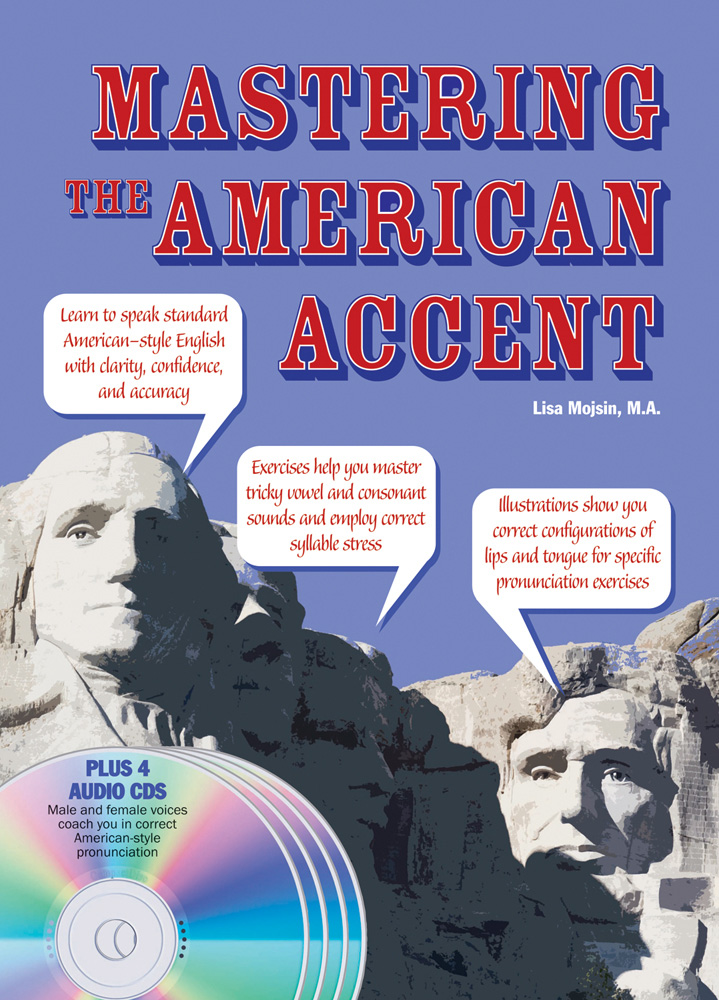
Mastering the American Accent — cover
Mastering the American Accent
Lisa Mojsin, M.A.
Director, Accurate English, Inc.
Los Angeles, CA

Acknowledgments

This book is dedicated to my accent reduction students who came to the United States from all parts of the globe. Their drive to excel, passion for learning, amazing work ethic, and belief in the American dream have inspired me to write this book. In the words of Henry David Thoreau, “Go confidently in the direction of your dreams. Live the life you have imagined.”

Thanks to all of the supportive and extremely professional people at Barron’s: Dimitry Popow, my editor; Wayne Barr for seeking me out to write this book; and Veronica Douglas for her support.

I am enormously grateful to Lou Savage, “The Voice.” His is the beautiful male voice on the recordings. He was also responsible for all of the expert audio engineering and audio editing. Thank you, Lou, for being such a perfectionist with the sound and insisting on fixing the audio “mistakes” I couldn’t hear anyway.

I am also grateful for the contributions of Maryam Meghan, Jack Cumming, Katarina Matolek, Mauricio Sanchez, Sabrina Stoll, Sonya Kahn, Jennie Lo, Yvette Basica, Marc Basica, and Laura Tien.

© Copyright 2009 by Barron’s Educational Series, Inc.
All rights reserved. No part of this publication may be reproduced or distributed in any form or by any means without the written permission of the copyright owner.
Address all inquiries to:
Barron’s Educational Series, Inc.
250 Wireless Boulevard
Hauppauge, NY 11788
www.barronseduc.com
ISBN-13: 978-0-7641-4185-0 (book only)
ISBN-10: 0-7641-4185-6 (book only)
ISBN-13: 978-0-7641-9582-2 (book & CD package)
ISBN-10: 0-7641-9582-4 (book & CD package)
Library of Congress Control Number 2008938576
Printed in the United States of America
9 8 7 6 5 4 3 2 1

Contents

Introductionvi Chapter 1: The Vowel Sounds1 Main Vowel Sounds of American English1 Production of Vowels2 /i/ as in meet3 /ɪ/ as in sit3 /eɪ/ as in take5 /ɛ/ as in get6 /æ/ as in fat7 /ɑ/ as in father8 /ɘ/ as in fun9 /ɔ/ as in saw10 /oʊ/ as in boat12 /ʊ/ as in good13 /u/ as in too13 /ɘr/ as in bird15 /aɪ/ as in time15 /aʊ/ as in house16 /ɔɪ/ as in boy17 Chapter 2: Vowels in Detail18 Review of /ɪ/ and /i/ Sounds18 Review of /ɛ/ and /æ/ Sounds19 Review of /ɘ/, /ɑ/, /ɔ/, and /oʊ/ Sounds20 The Problematic o21 The American /ɔ/ Sound23 Review of /ɛ/, /æ/, /ɑ/, /ɔ/, /ɘ/, and /oʊ/25 Review of /ʊ/ and /u/ Sounds25 Comparing /u/ and /yu/26 Review of the /ɘr/ Sound27 Vowels Followed by the /r/ Sound27 Chapter 3: Consonants29 Forming American Consonants29 Voiceless and Voiced Consonants30 Vowel Length and Voiced and Voiceless Consonants31 Stops and Continuants33 Chapter 4: Problematic Consonants34 The Various t Sounds of American English34 The “Fast d” Sound38 The /tʃr/ Sound: tr39 The /dʒr/ Sound: dr39 The /dʒ/ Sound: du and d + y40 The /tʃ/ Sound: tu and t + y40 Words Ending in -ed41 The th Sound44 The American /r/48 The American /l/50 Understanding /l/ Versus /r/52 The /v/ Sound54 Understanding /b/ Versus /v/55 The /w/ Sound56 Understanding /v/ Versus /w/58 The /s/ and /z/ Sounds59 The /ŋg/ Sound: Pronouncing ng62 Consonant Clusters63 Chapter 5: Syllable Stress66 Stressed and Reduced Vowels66 Dangers of Stressing the Wrong Syllable68 General Rules for Stress Placement69 Two-Syllable Words69 Noun and Verb Pairs70 Words Ending in -tion and -ate71 -ate Endings of Verbs and Nouns71 More Stressed Suffixes72 Rules for Prefixes72 Syllable Stress Changes74 Reduced Vowels for Review76 Chapter 6: Word Stress78 Compound Nouns78 Proper Stress with Adjectives80 Phrasal Verbs81 Noun Forms of Phrasal Verbs82 Abbreviations and Numbers83 Names of Places and People83 Word Stress Within a Sentence84 Lengthening the Main Vowel in Stressed Words84 Which Words Should I Stress?85 Content Words85 Content Words in Detail: Verbs86 Stress Nouns but Not Pronouns87 Content Words in Detail: Adjectives87 Reducing Vowels in Unstressed Words88 Weak Forms89 Strong Forms90 Thought Groups and Focus Words91 Contrastive Stress92 Chapter 7: Intonation95 Falling Intonation95 Statements95 Questions95 Rising Intonation96 Non-Final Intonation97 Unfinished Thoughts97 Introductory Words98 Series of Words98 Expressing Choices98 Wavering Intonation99 Chapter 8: Sound Like a True Native Speaker101 Linking Words for Smoother Speech Flow101 Rules for Linking102 Linking Consonant to Vowel102 Linking Consonant to Same Consonant103 Final Stop Between Consonants104 Linking Vowel to Vowel104 Linking Vowels Within a Word105 Reducing Pronouns107 Contractions108 Commonly Contracted Words109 Conditional Tense and Contractions113 Casual Versus Formal Speech115 Rules and Patterns of Casual Speech116 Commonly Confused Words118 Chapter 9: Memorizing the Exceptions119 Same Spelling, Different Pronunciation119 Two Correct Pronunciations120 Especially Difficult Words121 Words with Dropped Syllables123 Words with Silent Letters124 Homophones125 Native Language Guide127 Chinese127 Farsi135 Filipino Languages138 French141 German146 Indian Languages150 Indonesian154 Japanese158 Korean162 Portuguese166 Russian170 Spanish174 Vietnamese179 Index184
vi · Mastering the American Accent

Introduction

This book will help non-native speakers of English learn to speak with an American accent.

Which American Accent Will This Book Teach Me?

You will learn to produce the standard American accent. Some people also call it “broadcaster English.” It’s the kind of standard, neutral speech that you hear on CNN and in educated circles. It’s a non-regional American accent, meaning that people do not associate the dialect with any particular part of the United States. It is the accent most commonly associated with educated people in the American East, Midwest, and West.

How Should I Practice?

Listen to the recorded material over and over. You will hear words and sentences pronounced followed by a pause for you to repeat after the speaker. You may want to record yourself repeating so that you can compare your accent to the accents of the speakers on this audio. Then practice the new sounds in real-life situations.

There are numerous study tips throughout the book, both from the writer and from her many successful students who have greatly improved their American accent. For an individual professional analysis of your accent which will help you to study accent reduction more efficiently and tell you which sections of this book you should focus on most, please contact us at 1-800-871-1317 or visit our website at: masteringtheamericanaccent.com.