CONSONANTS
This chapter will teach you how to form all of the consonant sounds of American English. You can either study this chapter first to get an in-depth understanding of how consonants are formed, or you can just skip to the next chapter (“Problematic Consonants”) and begin practicing the most difficult sounds for non-native speakers. Make sure that you also refer to the “Native Language Guide” at the end of the book, which will tell you which specific consonant sounds you need to focus on in this chapter and in the following one.
Forming American Consonants
When you are learning another accent, it is very helpful to know how the instruments of the mouth work together to produce sound. One reason that you have an accent when you are speaking English is that you are likely not moving your tongue and lips in the same way as a native speaker.
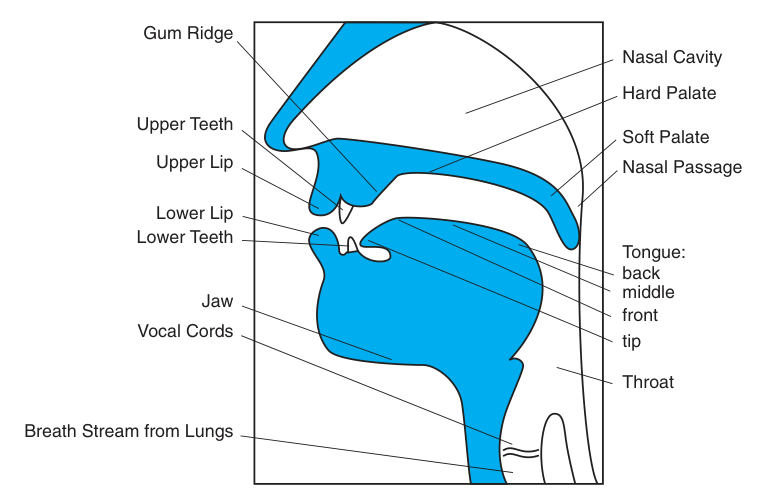
A consonant is a sound that is made when the airflow is blocked by either your lips or your tongue. The different places where this block may occur are called “points of articulation.” The point of articulation is, therefore, a point of contact of one part of your mouth with another part. For example, when you produce the sound /p/ (which is spelled with the letter p) your lips come together and close shut. So, the points of contact here are your two lips. The sound /b/ (which is spelled with a letter b) is also produced by your lips touching, as is the sound /m/.
Sometimes the points of contact, or points of articulation, occur when the tip of your tongue touches directly behind the upper teeth, a part of your mouth called the gum ridge. The sounds that are produced at this point are /t/, /d/, /n/, and /l/. Another point of contact occurs when the back part of your tongue touches the back part of your mouth, near the throat, as in /g/ and /k/. You don’t necessarily need to learn the formal names of the different parts of your mouth, but you should develop an awareness of where the points of contact are. Studying the illustration below will help you do this.
Voiceless and Voiced Consonants
One way that we categorize consonants is by determining whether they are “voiceless” or “voiced.” It’s important to know the difference between these types because the length of a vowel that precedes a consonant is determined by whether the consonant that follows it is voiceless or voiced. You will learn more about this later in the chapter. Also, knowing whether a sound is voiceless or voiced will help to correctly pronounce letters such as -ed and -s at the ends of words. You will learn about this in detail in the next chapter.
First, let’s learn how to distinguish between a voiced and a voiceless consonant. Place your fingers in the front, middle part of your neck. Now say /z/ as in the word zoo. Now, let’s make it longer: zzzzzzzzzz. You should feel a vibration in your vocal cords. This is how you know that the /z/ sound is voiced. Now let’s try this with the /s/ sound as in the word sat. Say /s/. Now let’s prolong it: sssssssss. This time there was no vibration in your vocal cords, so this consonant is considered unvoiced. That’s all there is to it. The tongue and lip positions of the /z/ and /s/ are identical. The only difference between them is vibration or no vibration. Look at the other consonant pairs that are produced exactly the same way, except for the vibration in the vocal cords.
Voiceless and Voiced Consonant Pairs
More Voiced Consonants
Now let’s go through the rest of the consonant sounds of English. These consonants are all voiced, but they have no voiceless pair. Make sure that you feel the vibration in your vocal cords as you say them.
The Consonant /h/
This final consonant sound is voiceless and does not have a “voiced pair” that it corresponds to.
Vowel Length and Voiced and Voiceless Consonants
Vowels are longer when followed by a voiced consonant. They are shorter when followed by a voiceless consonant. Even short vowels like /i/, /ɛ/, /ɘ/, and /ʊ/ are prolonged when followed by a voiced consonant.
When you lengthen a vowel, make sure that you do not change the sound of the vowel. For example, when you say hid make sure that it doesn’t sound like heed.
Word Pairs for Practice
Practice Sentences
Word Pairs in Sentences
Stops and Continuants
There is another important way that consonants are categorized, besides whether they are voiced or voiceless. Consonants can either be “stops” or “continuants,” depending on whether the airflow is stopped or if it is continued. For example, when we say the /s/ sound we can prolong it by saying “yessssssss.” The /s/ sound is considered a continuant because the air flow can continue as long as we have air in our lungs. But if we say a word like “job,” we cannot continue the final consonant, /b/. We stop the airflow by closing our lips. Therefore, /b/ is a stop. If we quickly open our lips, we can then “release” the stop and say job.
Holding Final Stops
Americans generally do not release many of the final stops. For example, when they say the sound /p/ in the word stop, the lips stay closed. No air comes out. This creates almost a silent version of the sound /p/, or a half p. We know the p is there, but we don’t hear all of it. If the lips were released, there would be a slight puff of air.
Let’s try another stop: the sound /g/. When you say the word big, don’t release the /g/. Make sure that your tongue remains up in the back of your mouth when you are done saying the word.
Words for Practice
Pay special attention to the final consonants as you pronounce the words in each column.Final Stops Followed by Consonants
The final stop is always held when the next word within the same sentence begins with a consonant. However, when a word with the final stop is at the end of a sentence, the rule is much more flexible. The final sound can either be held or released.