THE VOWEL SOUNDS
In this chapter you will learn how to accurately pronounce all of the main American English vowel sounds. The English alphabet has five vowels, a, e, i, o and u, but it has about 15 main vowel sounds. For some learners this is one of the most difficult aspects of American English to master. Speakers of languages with fewer vowel sounds are likely to speak English using only the same number of sounds that exist in their native language. Sometimes they do not even hear the distinction between certain sounds in English. Consequently, non-native speakers might pronounce “hill” and “heal” the same way. Similarly, the words sell and sale, or cup, cop, and cap may also sound the same when spoken by a non-native speaker.
Because there is not always a direct relationship between how a word is spelled and how it is pronounced, you should become familiar with the phonetic symbols that represent the sounds that you are learning. This way, you will be able to use your dictionary when you come across a word that contains a vowel sound that you don’t know how to pronounce. Make sure you also become familiar with the phonetic symbols of your dictionary as they may be a bit different from the symbols that this book uses.
Main Vowel Sounds of American English
Production of Vowels
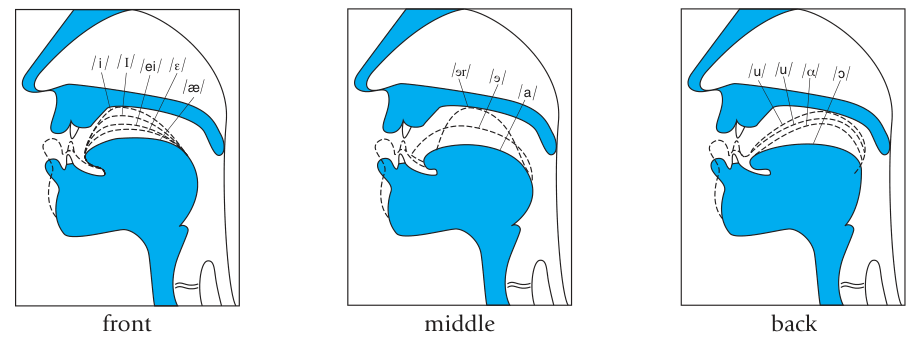
We categorize vowels as front, middle, or back depending on which part of the tongue is used to produce the sound. For example, /i/ is a front vowel because the front part of the tongue goes up in the front of the mouth, and /u/ is a back vowel because the back of the tongue goes up in the back of the mouth. We also categorize vowels as high or low. In high vowels, the tongue is pushed up high near the roof of the mouth as in /i/, and in low vowels, the tongue is flat down at the bottom of the mouth, as in /æ/.
Diphthongs consist of two different vowel sounds that are closely joined together and treated as one vowel. They are represented by two phonetic symbols. To create this sound, move your tongue smoothly from one vowel position to another. The following vowels are diphthongs: /eɪ/ as in take, /oʊ/ as in boat, /aɪ/ as in time, /aʊ/ as in house, and /ɔɪ/ as in boy.
You will now learn how to correctly pronounce each type of vowel. Refer to the diagrams below to help you better understand the correct tongue and lip positions for these various vowel sounds.
Common Spelling Patterns for /i/
Word Pairs for Practice
Practice Sentences
Common Spelling Patterns for /ɪ/
Word Pairs for Practice
Practice Sentences
Word Contrasts for /i/ Versus /ɪ/
Make sure you don’t pronounce these pairs of words the same.Word Pairs for Practice
Make sure the two words in each pair are pronounced with different vowel sounds.Common Spelling Patterns for /eɪ/
Word Pairs for Practice
Practice Sentences
Common Spelling Patterns for /ɛ/
The verb say is pronounced with the /ɛ/ sound in the past tense form and in the present tense form when it is followed by an s.
Word Pairs for Practice
Practice Sentences
Word Contrasts for /ɛ/ Versus /eɪ/
Make sure you don’t pronounce these pairs of words the same.Word Pairs for Practice
Make sure the two words in each pair are pronounced with different vowel sounds.Common Spelling Patterns for /æ/
Word Pairs for Practice
Practice Sentences
Word Contrasts for /ɛ/ Versus /æ/
Make sure you don’t pronounce these pairs of words the same.Word Pairs for Practice
Make sure the two words in each pair are pronounced with different vowel sounds: /ɛ/ or /æ/.Common Spelling Patterns for /ɑ/
Word Pairs for Practice
Practice Sentences
Word Contrasts for /æ/ Versus /ɑ/
Make sure you don’t pronounce these pairs of words the same.Word Pairs for Practice
Make sure the two words in each pair are pronounced with different vowel sounds: /æ/ or /ɑ/.“During my drive to and from work, I always listen to audio books. The speaker’s voice is usually very clear and not sloppy like the speech I sometimes hear on the street. I listen closely to the accent of the speaker and try to imitate it. I play back certain parts over and over again. The more I do this the better my accent gets.”
Common Spelling Patterns for /ɘ/
*The IPA (International Phonetic Alphabet) symbol for the stressed vowel is /ʌ/ and for the unstressed vowel it is /ɘ/. They are basically the same sound. Throughout this book the /ɘ/ will be used for both. For further study of this reduced, neutral sound, refer to Chapter Five, which deals with syllable stress and reduced vowels.